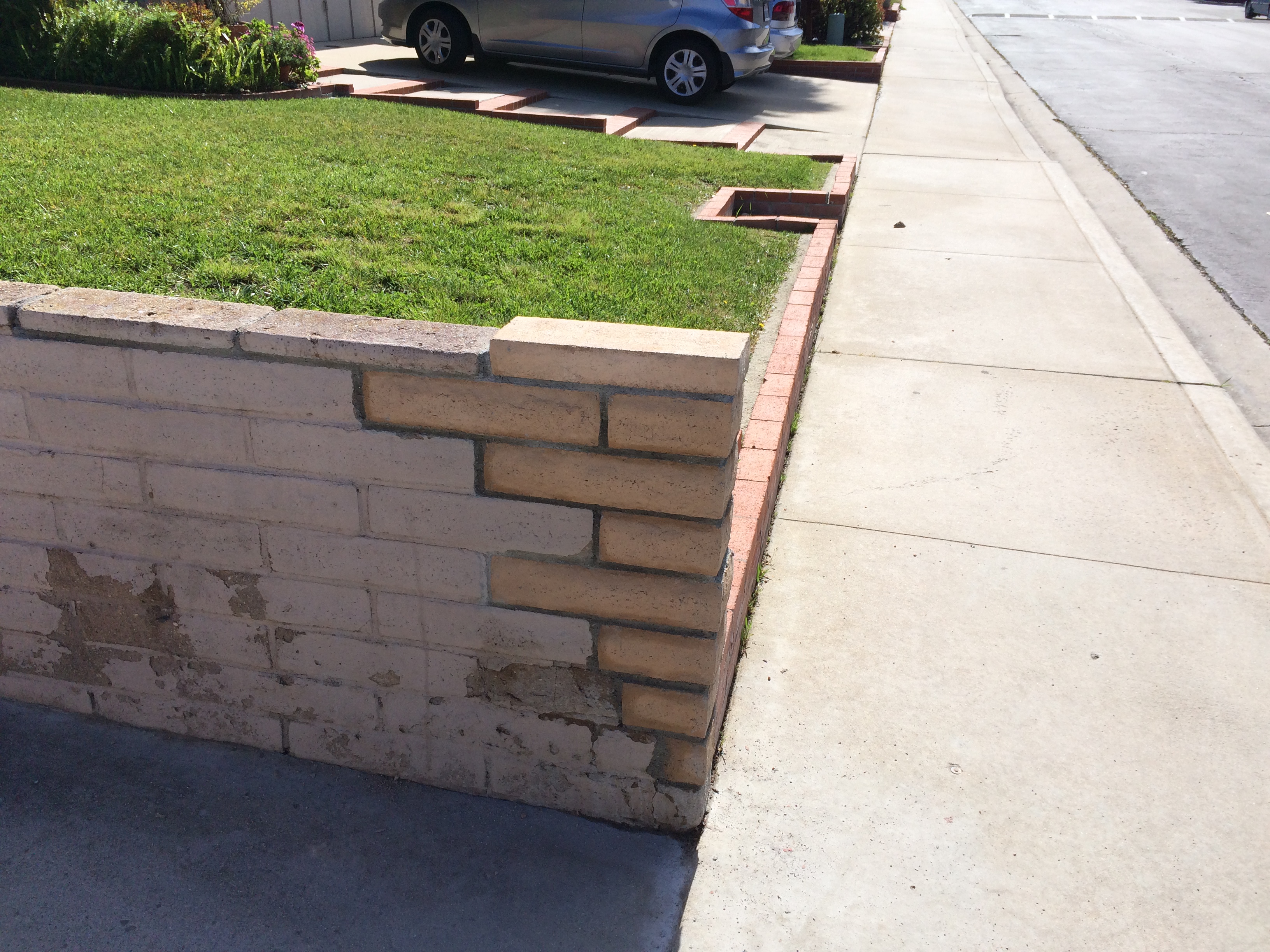
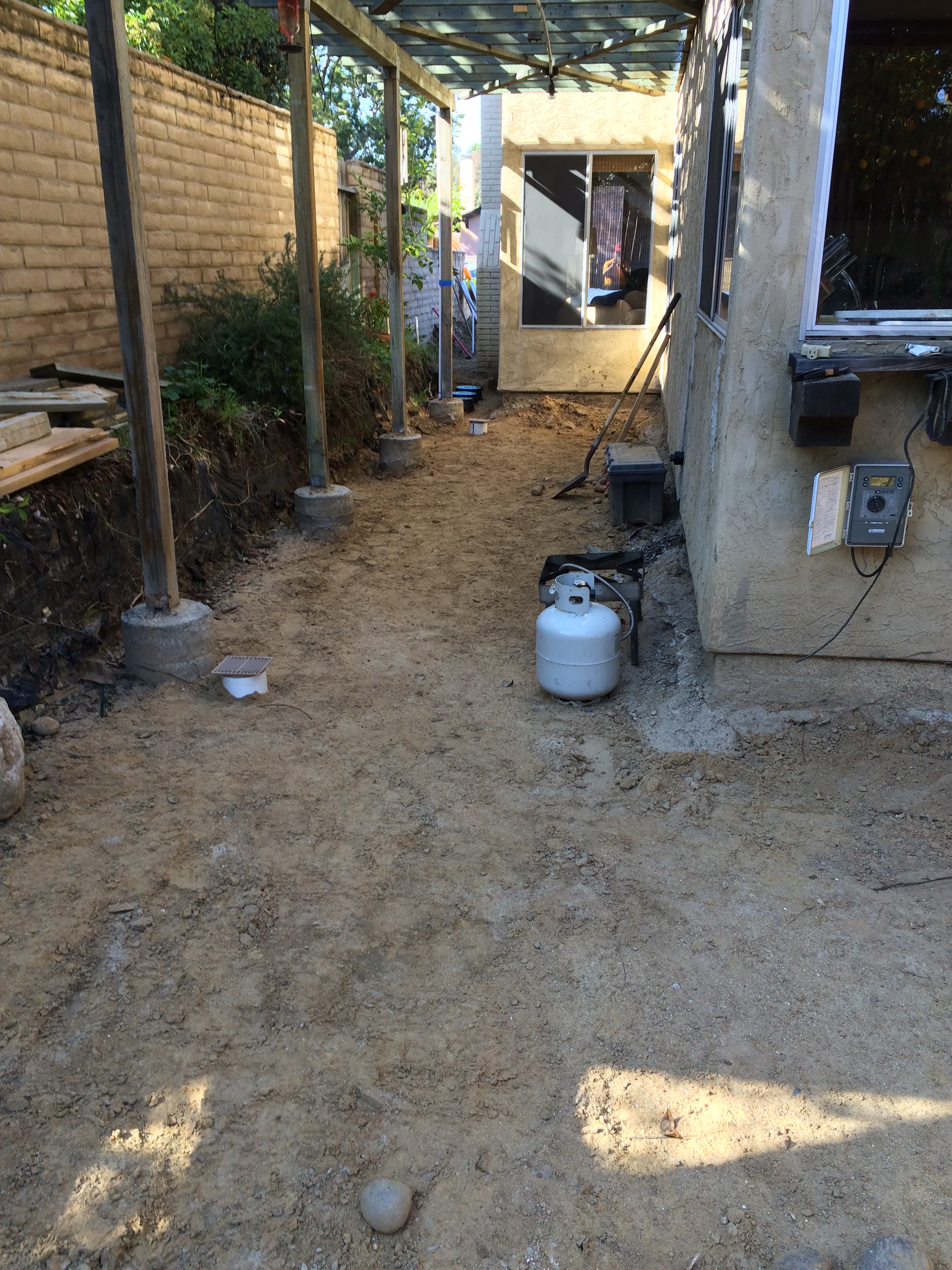
How To Build a Keystone Retaining Wall

Today, I finished the majority of the hardscape of my front yard (if you don’t count the concrete for the walkways and driveway aprons). This is, in a sense, a milestone because, from now on, I will no longer be moving around dirt, but actually putting it in its final resting place. Plus, it’s pretty cool to see the design manifest in physical reality. A lot of the hardscape is done with Keystone blocks for the retaining walls, and because I ran into some challenges during the installation and came up with some solutions, I wanted to share those with you; hence the subject for today’s blog entry.

First, a disclaimer: The instructions that I’m providing are the way that I came up with. They are by no means the ONLY right way to accomplish this task and, indeed, deviate from some of the recommendations on the manufacturer’s and distributor’s websites. I will provide my reasoning for these deviations as I go. Having said that (whew!), let’s get started!

Keystone retaining walls are a wonderful example of smart design and engineering. The company has figured out how to put together walls with specialty engineered Concrete Masonry Units (CMU’s) that do not require mortar. Just like Lego. Fit them together, and voila! A sturdy, attractive, easy to build wall. Perfect for the DIY’er. In fact, the videos that the company puts out makes it seem like putting up a retaining wall is a breeze. And at some points during the construction, it is. But don’t let the sales videos fool you. Putting up a retaining wall, as with any other permanent structure, requires attention to detail, and a lot of scut work, as I will detail later in this blog entry. Still, for a DIY’er, it’s a great solution.

Keystone has many different wall systems to choose from. I had previously installed a Keystone “Garden Wall” during a previous remodel where I replaced old rotten wood with a “real” retaining wall. Wood is not a good material to use as a retaining wall because it, eventually, will decompose. Masonry doesn’t decompose, so that’s the long-term solution. So, a “Garden Wall” was the system I decided to use going forward, mainly because I wanted to make use of what I already had. I ordered the materials (more Keystone Garden Wall blocks) from a local manufacturer (RCP Block and Brick) whom, I assume, has a franchise agreement to produce these CMU’s locally to Keystone’s standards. Now the tricky part.

The Keystone website has an installation page that shows an idealized portrayal of an attractive couple putting up a retaining wall. And the website has some very essential information on how to properly complete the installation. But nevermind the hype, or how “easy” they make it seem. Did you ever watch a cooking show where the chef makes it look easy and throws everything together in a matter of minutes, and you have a perfectly cooked, delectable meal? Well, forget it. They didn’t show the toil and tribulation of the underpaid and underappreciated proletariat doing all of the prep work. THAT agonizing, laborious PREP WORK is what you, as a DIY, will have to do. Forget the good looks and focus on the hard work ahead, but with a vision that your creation will be as remarkably beautiful, as it is pleasurable to work on.

To begin with, you need a design from which to do the layout work, and from which to estimate materials. I discuss the design process in some of my other blog posts, so I won’t go into detail here, except to refer you to the design that I’m working from.

LANDSCAPE PLOT PLAN

LANDSCAPE PLOT PLAN


The first task is the layout, where you transfer the dimensions in your plan to the dirt. The most important aspect of the layout is to choose the reference points from which you will measure. For this example, I’m laying out the center planter, so I wanted to make sure that the planter was centered between the two sides, and at a specified distance from the outside retaining wall to allow for a comfortable pathway. If you’re doing the layout on a relatively flat surface with no obstructions, then a measuring tape will usually do. For this layout, I couldn’t lay a measuring tape flat, so I strung a mason’s line and used a plumb bob to measure down vertically. This turns out to have a second advantage, which is that you need to measure vertically to establish the height of the base course. I used little flags and marking paint to mark the layout on the dirt.


Layout of the center planter. Notice the string that I used to set the height.
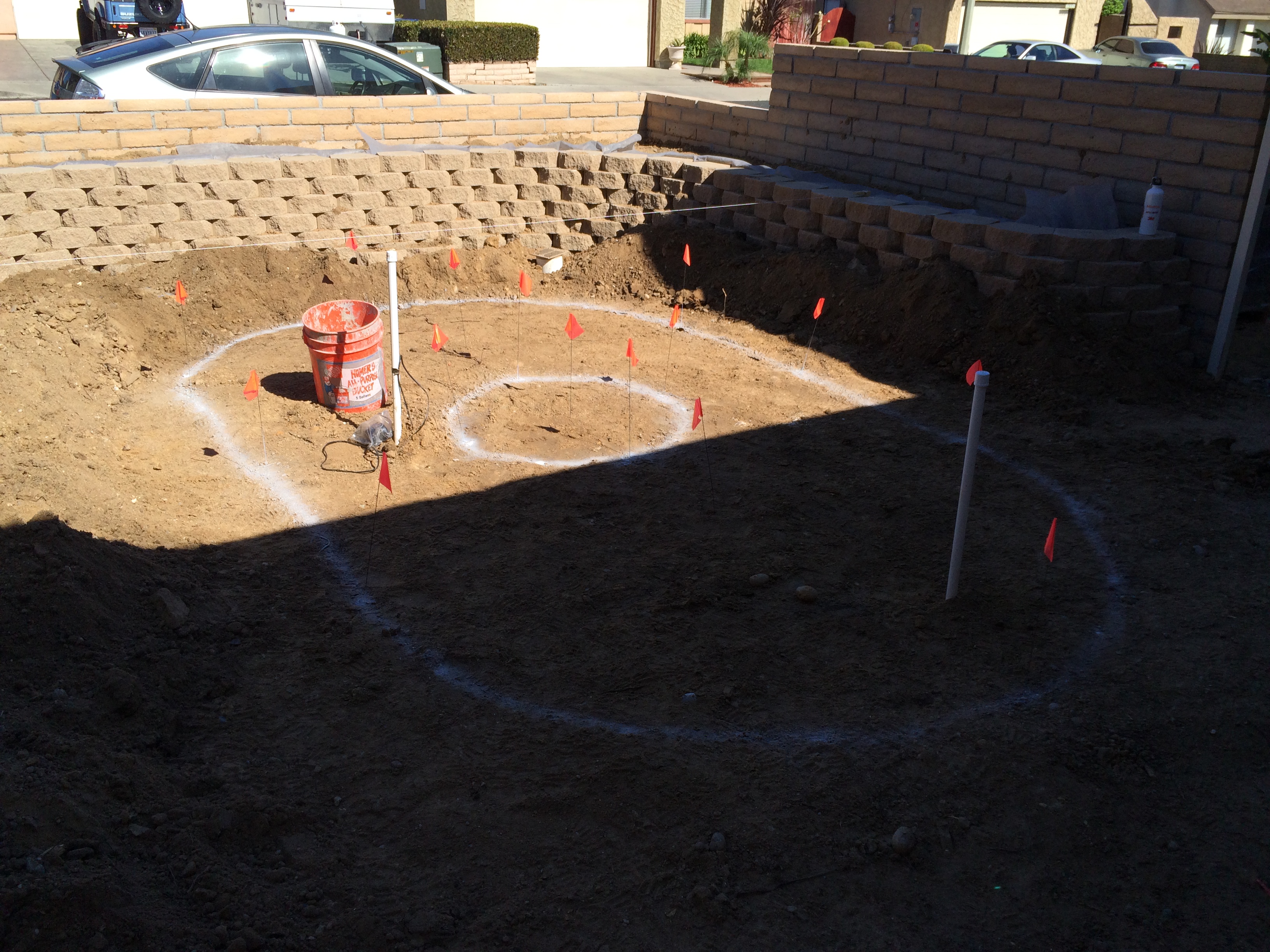
Layout of the center planter. Notice the string that I used to set the height.

Another view of the layout.

Another view of the layout.


Just for fun, I decided to check the level of the string, which would tell me if the outer retaining walls that I just built were good. Look at that! Dead on, which validated my process for laying out the base course.

Just for fun, I decided to check the level of the string, which would tell me if the outer retaining walls that I just built were good. Look at that! Dead on, which validated my process for laying out the base course.


It is vitally IMPORTANT to make SURE you have a level base and that your first course is aligned properly. The nice-looking couple portrayed on the Keystone installation page make you think this is relatively easy. From my personal experience, I will tell you that this process is difficult, time-consuming, and frustrating. And you must be able to stomach these facts if you really want a nice, professional, retaining wall. The way I established the height of the base course was to use my vertical reference (the outside retaining wall) and drop a plumb line to where I wanted the first course to start. At least one course needs to be fully buried, so that was taken into account in the measurement. I then located the first block as precisely as I could, measuring from the reference “flags” that I previously planted, and then did a lot of fussing around to get that first block level, square, plumb, and in the position that I wanted it. Once I had the first block in position, I went around the circumference of the layout to place other “reference” blocks so that I could work to those as I continued to set the base course.

I had to do a lot of trial-and-error to come up with a technique to reliably and quickly place the subsequent blocks in alignment. Professionals will dig a shallow trench, fill it with gravel, and then use a mechanical compactor to level the gravel. This is a great idea if you’re building a large retaining wall, or in an area that gets a substantial amount of rain, because waterlogged soil puts a lot of pressure on the wall and it’s important to have good drainage. I will probably do that on my back retaining wall due to the height, but for a small wall (12″) in an arid climate, I decided this was overkill. As a DIY’er, I’m always looking for a reasonable shortcut. At any rate, the method I came up with was this:
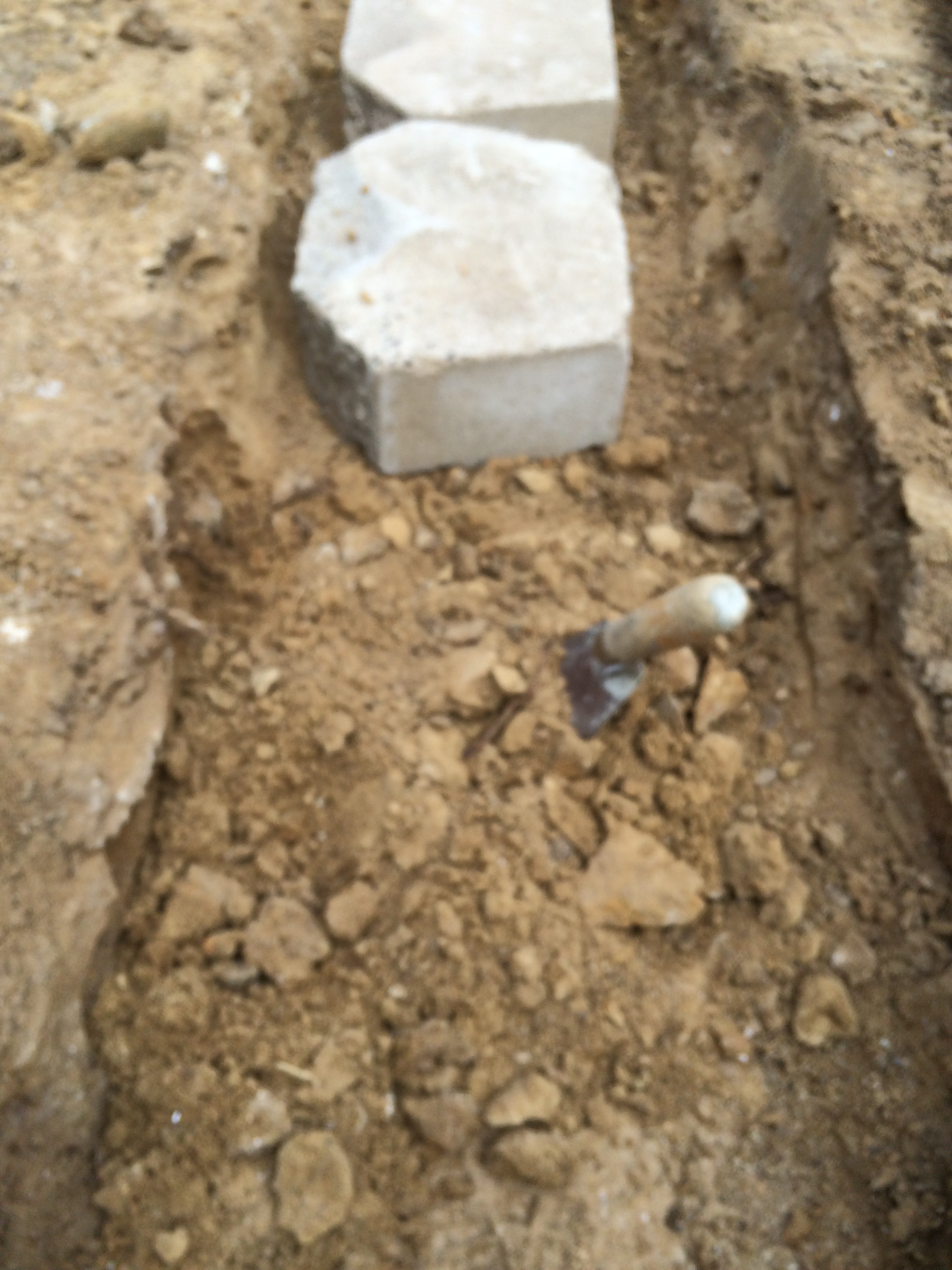
Loosen the dirt with a trowel.

Loosen the dirt with a trowel.

Level the dirt. Try to level a little bit above the bottom of the previous brick.

Level the dirt. Try to level a little bit above the bottom of the previous brick.


Plop the brick down to compact the dirt and align it with the previous brick. Check the cross-level. Looks good! (I was lucky.)

Check the back-and-forth level. This is very important because you will use this as a reference for your next brick. This one is not so good.
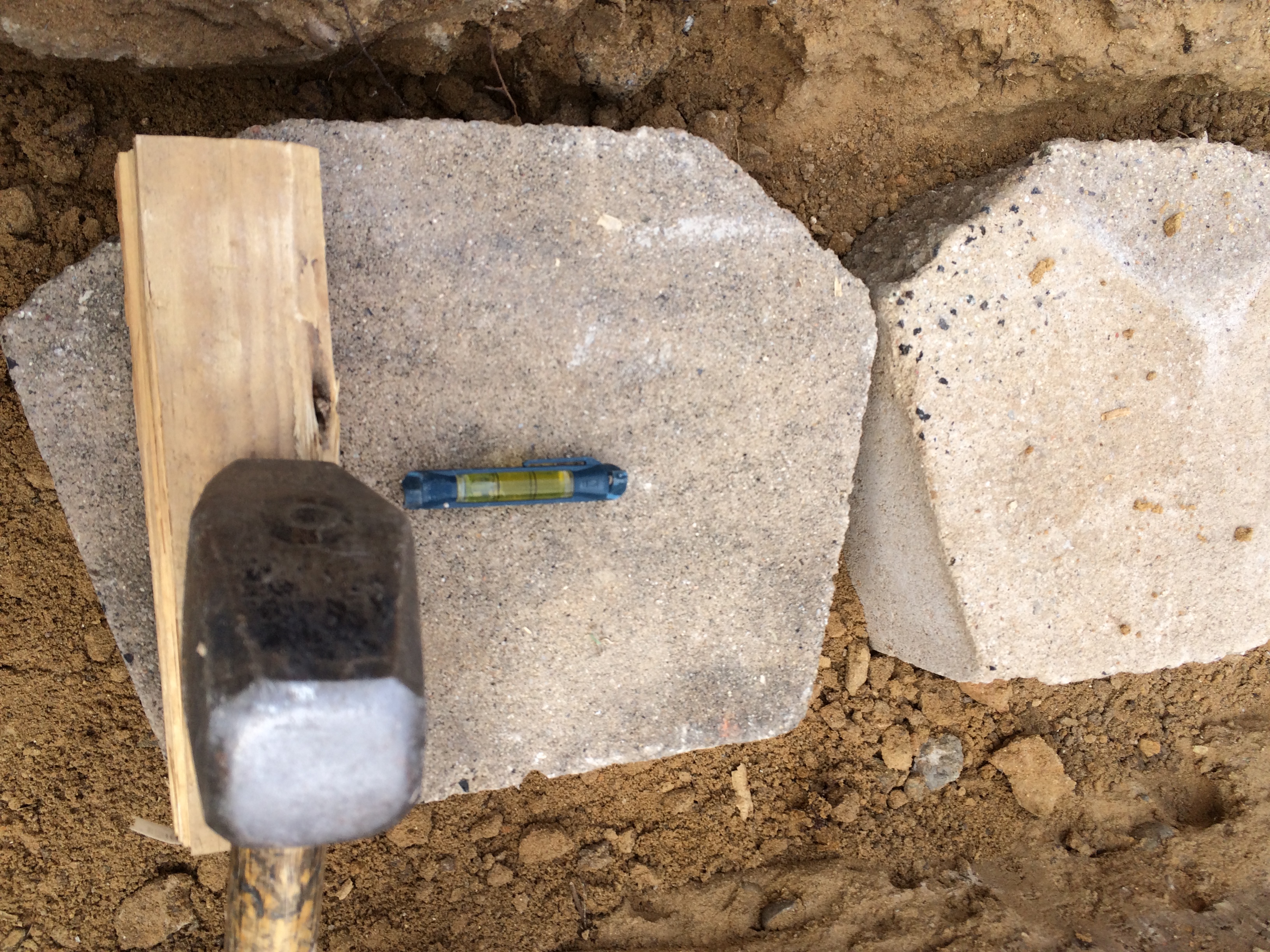
Check the back-and-forth level. This is very important because you will use this as a reference for your next brick. This one is not so good.


Beat on the high side with a hammer using a wooden block to protect the brick. This hammer is called an "Engineer's" hammer. In the Navy, we referred to this as a "persuader". Draw your own conclusions.

Beat on the high side with a hammer using a wooden block to protect the brick. This hammer is called an “Engineer’s” hammer. In the Navy, we referred to this as a “persuader”. Draw your own conclusions.
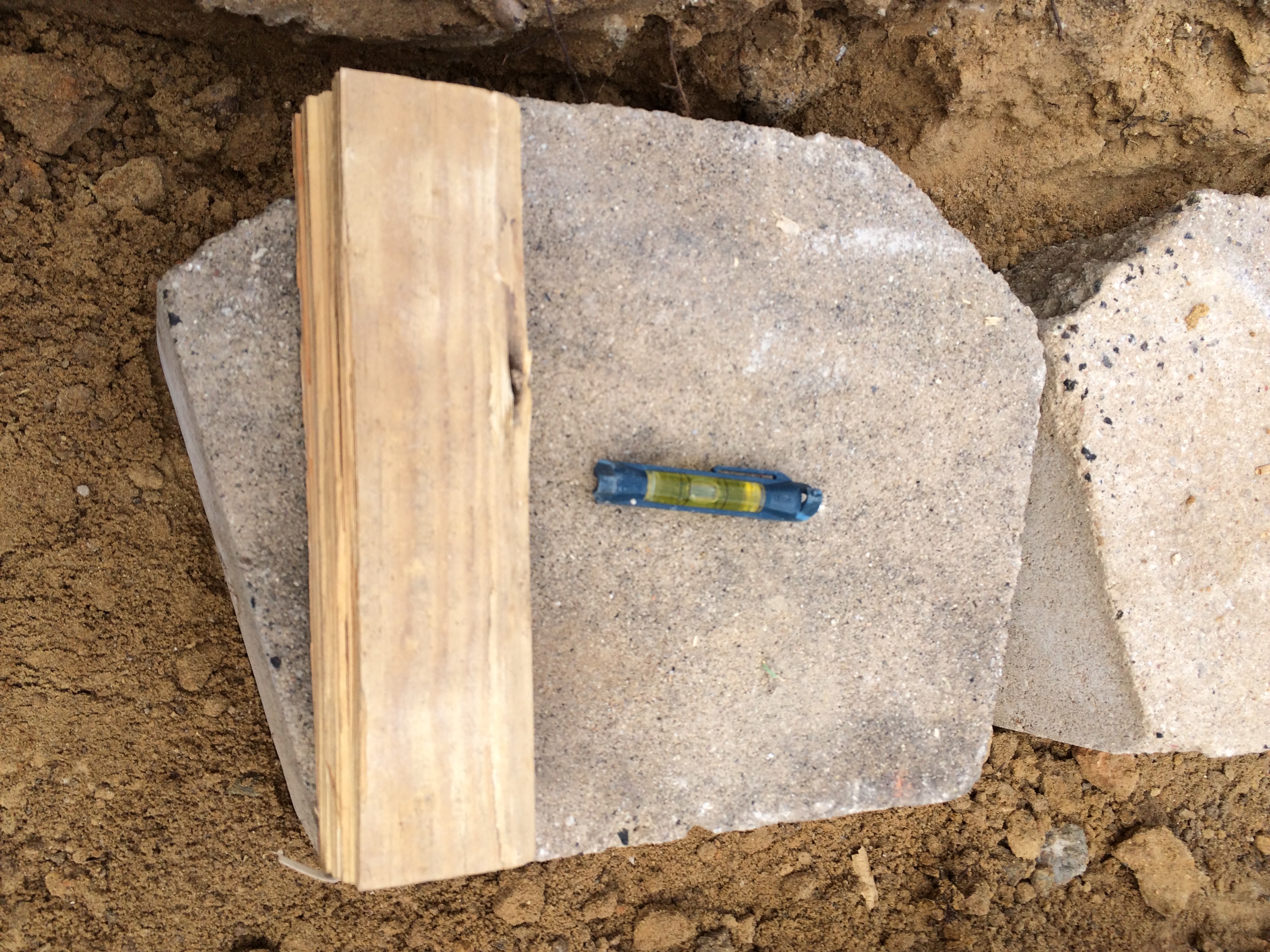
Level after "persuasion". Looks good!

Level after “persuasion”. Looks good!


Check the level from the previous brick to make sure that you're at the same height.

Check the level from the previous brick to make sure that you’re at the same height.
Check the alignment with your previous bricks. You don't want your wall to unintentionally start to meander. NOTE: if you're placing the blocks along a curve, then you need to measure the curve radius from a reference point.

Check the alignment with your previous bricks. You don’t want your wall to unintentionally start to meander. NOTE: if you’re placing the blocks along a curve, then you need to measure the curve radius from a reference point.


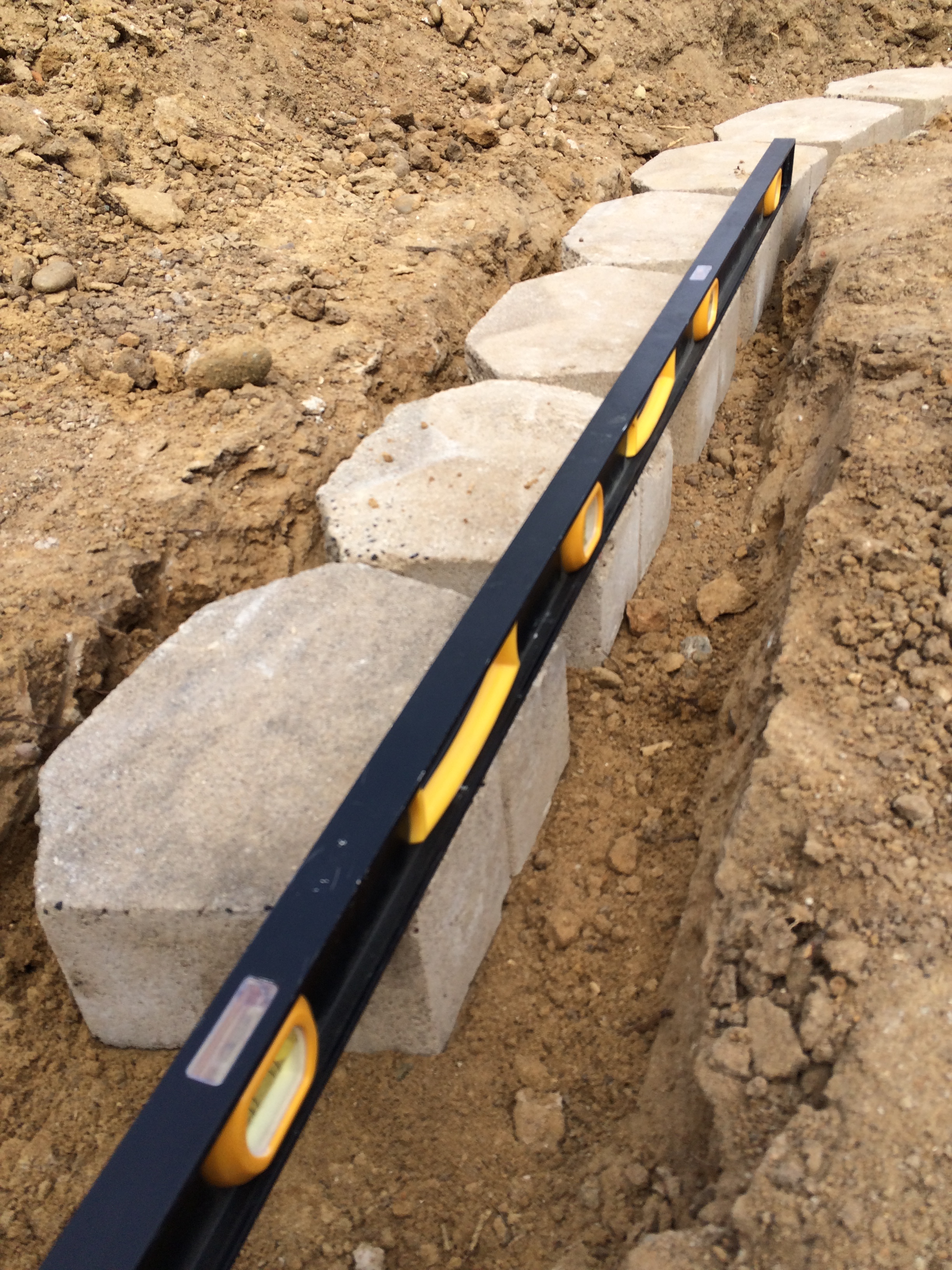
Check your level using a long level to make sure that you're keeping a good level all the way around.

Check your level using a long level to make sure that you’re keeping a good level all the way around.


One of the tricks I came up with was to chip off the shoulder that protrudes from the back of each brick. This shoulder is very important because it serves to lock each course to the course below. However, for the base course, it only gets in the way and adds unneeded complexity to the leveling process. So I decided to chip it off for the base course bricks, as shown in this brief video:

Base course, all laid out!

Base course, all laid out!


Now that the base course is all in, the job goes really fast. The hardest part is to lug these 30 lb. bricks from your staging area and plop them onto the course below. It’s a simple matter to align the edge of each block to the one next to it, and then to make sure that the shoulder (which you didn’t cut off for these bricks), rests firmly on the course below. The only challenge here is that you need to make sure that each subsequent course is “on bond” which means the brick on top is placed directly over the seam formed by the two bricks below. No big deal if you’re dealing with a straight line, but the bricks will go “off bond” on curves. This is because that shoulder displaces each course inward by about 1″, meaning that the radius of the curves get progressively shorter for outside curves, and larger for inside curves. In this case, I did what the manufacturer recommended, which was to make sure that the straight courses were on bond, and then work towards the middle of the curves. Inevitably, you will find yourself with a space that is too small for a standard brick, in which case, you will need to cut a brick to fit. While it is possible to do this by hand with a brick hammer, it is way easier to use a 7″ grinder with a wet-dry masonry diamond wheel. Fortunately, Santa Claus had the foresight to deliver this to me in my stocking this past Christmas, so I was all set! Seriously, if you are doing a fair amount of masonry work for a hardscape (brick walls, retaining walls, brick patios, etc.), this tool is well worth the money.

Once you have a couple of courses in, it’s important to backfill. This is because the Keystones lock with outward pressure due to the shoulders, but will fall inward if you stack them too high. The manufacturer and distributor both recommend backfilling with gravel, but that could be a major PITA (not the bread). If this were a big time retaining wall in a wet environment, I would do it, but for this little project, I decided to forego the added expense and construction complexity.

One other feature that I added to this wall was to put landscape fabric on the inside of the wall. This prevents plants from growing in between the seams of your brick, and it worked extremely well for a previous wall that I built. This feature is not in any of the manufacturer or distributor instructions, but I know of folks who have made these walls without the landscape fabric, and they constantly struggle with weeds growing out of their walls. This is cheap insurance and better for the environment than spraying a bunch of chemicals all over your wall. Here are some pictures of the finished product.

Two courses on top of the base course with landscape fabric. Ready for backfill.
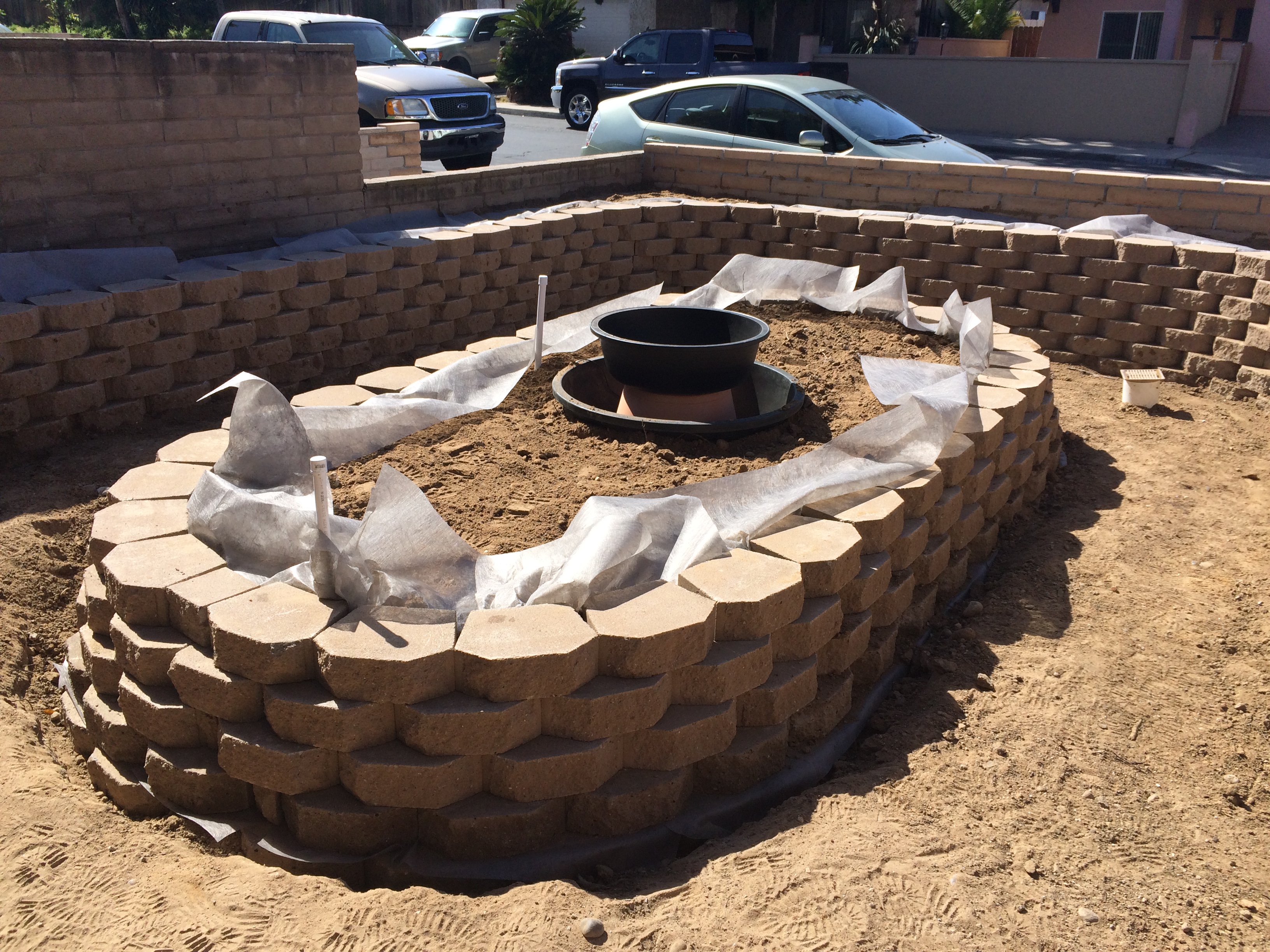
Two courses on top of the base course with landscape fabric. Ready for backfill.

Finished center planter.

Finished center planter.


Becoming A Mason — Building A Brick Wall

So, after a MONTH of work, I finally finished this brick wall. Initially, I was planning to be all done on the BIG WEEKEND, President’s day, and my aim was to BUILD THIS WALL! Alas, I was seriously over-optimistic about the time it would take. (Really?) It turns out that masonry is pretty much a ball-buster, and I’ve been pouring all of my spare time into finishing the job.

Day One (2/13/15):

This was pretty much a “set up” day. I took the advice of my online mentor, Mike Haduck, and laid everything out dry. This was helpful because I found out where all the “warts” were and I had to  make some adjustments. The biggest goof was that I did not align my electrical conduit with the rebar. So I had to do a lot of cutting. I hope this will not weaken the wall too much. I also had to set up my workstations: where I would cut, where I would mix the mortar, and also figure out how to get materials from the workstations to the area of the work. This turned out to be pretty involved because I don’t have a lot of room to work with, especially when the building materials are taking up so much space. I ended up locating the brick cutting and mortar mixing operation on the opposite side of the driveway because it allowed me good room to cut the bricks, and a place to dump the water that I was using to keep the mixer clean between batches. The only downside was that I had to walk over every time I needed to cut a brick.

MIXING STATION. Moat catches water for drainage.

MIXING STATION. Moat catches water for drainage.


Handling the mortar turned out to be tricky. Never mind that the sacks of mortar mix weigh 94 lbs. It is possible to heft these bad boys into the mixer, dump the bag in, and then reach down and poke the bag with you brick hammer or trowel, and then extricate the paper sack. Get the mixer going and add water until you get a nice slump. Now the tricky part. You can’t just dump this into a bucket because it goes all over the place. So the sequence is: dump the mixer into the tub, use the trowel to scoop the mortar into a bucket, and haul the bucket to the area of work. From there, you can put the mortar onto your mortarboard, and get to work. Before I laid any brickwork, I rinsed out the mixer because I didn’t want the leftovers to harden up. A professional crew will have the mixer going all the time, and the apprentices will be hogging the mortar, which will be used as fast as they can make it. Not so with me, and I daresay any DIY working alone. Mortar has  approximately 2 hour working time, and I used all of it for the one bag. Actually, it was less than one bag, because I used some of it to make my lintel. But that was just as well because I had to work on buttering technique, and had to deal with uneven surfaces and pay a LOT of attention to laying that first course. If that is messed up, then all subsequent courses will have the same problems.

DRY LAYOUT

DRY LAYOUT


Day Two (2/14/15):

I started working at 7:00 AM and worked until 6:00 PM. Although I didn’t get to actually laying brickwork until 8:00 AM, due to some setup time and the fact that I had to extend a couple of rebars to the height of the finished wall, it was a long day of work. I finally learned the correct technique for buttering a brick. You have to hold the trowel at an angle to the edge, maybe 30º, but it is upside down! That is why settling the mortar on the trowel is so important — because it won’t fall off when you turn it upside down. I tried the wrist snap method, but alas, my forearms are too weak. So I started to bang the trowel onto the mortarboard, and that seemed to work. In addition, it is important to wet the end of the brick that you are trying to butter. The mortar won’t stick if the brick sucks out the water. Maybe that’s because I live in an arid climate. Nevertheless, Mike Haduck’s advice about having mortar stick to wet surfaces is germane.

Now, to laying the brick. It is extremely important to lay the brick down gently, and to have enough mortar to have the brick settle above and farther away than what will be the final position. You then jiggle the brick back and forth to settle it in the mortar, and then take some measurements. Is it level in both directions (longitudinal and side-to-side)? Is it aligned with the course (or line) below? Is it aligned with the course below to produce a running bond (meaning each course is spaced by 1/2 the length of the brick)? Now, I take a soft-headed hammer and gently tap the brick into its final position. Pro masons use the butt of their trowel, but I found that I always had mortar detritus that sticks to the trowel splatter over my nice clean bricks, so the hammer was a better choice (for me). I scraped off the excess on the outside, and returned that to the mortarboard.

After laying a few bricks, I went back and sponged off  the excess mortar and used a jointer tool to make nice concave lines in the joints. It’s important to keep up with this as you go along because the mortar tends to set up fairly quickly, so you only have a short amount of time to clean up and finish the joints nicely.

I also discovered that I had no concept of the size required for mortar joints between the bricks. This required me to make a few extra cuts to bricks which I had previously crafted due to a faulty dry layout. Alas, part of the learning process,

The other thing I discovered was that as the 2 hour limit approached, the mortar really started to set in the bucket. The solution was to finish whatever course I happened to be working on, and then dilute the remaining mortar with some water to give it some fluidity, and then dump it in the cells with the rebar. Those cells have to be filled up anyway, so use up what you have! I finally built up at least one course on each level and I anticipate that the work will go faster because (a) there are fewer obstructions (misplaced rebar and conduit), and my technique is improving with practice. One thing that I did NOT skimp on was accuracy. I take my time with each brick, making sure that is level and square, and then I check the line with my 6′ level to make sure that I’m not slowly going out of whack. Then I sight down the line, using my human ability of stereoscopic vision to see if everything is lined up straight. Never underestimate the accuracy of your eyes. They’re simple to use, and you can see if everything lines up if you take a few steps back.  It may be slow going, but nobody will care about how long it took, because they won’t know. If I were doing this for money, then I would be out of business pretty fast. That’s why pros can do in a day what will (likely) take me several more days. But I’m confident that my results will be professional grade. So far, it looks pretty good!

FIRST COURSES

FIRST COURSES


Day Three (2/15/15):

I’m beginning to really feel the strain. Masonry is hard work! There’s lot’s of lifting involved, and lots of repetition. That said, I’m finally developing a rhythm with mixing the mortar, cleaning up the mixer and the plastic tub I dump the mortar in after I mix it, putting the mortar in a 5 gallon bucket (it fills it up perfectly, so maybe that’s why it’s a 94 lb bag), and hauling the mortar out to where I’m going to work with it. I’ve come up with a sequence of using water which makes multiple uses of water to rinse out the mixer and various vessels so that I don’t use any more water than I have to. I’ve also discovered that the mortar needs a few minutes of mixing, so I let the mixer run while I pull the next set of blocks and lay them out so I’m not constantly walking back-and-forth to the pallet.

Finally, I decided to figure out a way to set up the mason’s line. What a difference!!  I couldn’t find a “how to” on YouTube (at least very easily), so I made my own video, and you can see it at the end of this blog post. At any rate the  mason’s line practically eliminates the necessity to carefully tweak each brick and use a level multiple times. That being said, there is still a lot of work to be done after the brick is put in place. You have to use a jointer to clean up the excess mortar in the joints, and then go over all the bricks with a sponge and a wire brush, wetting the bricks generously, to get off the excess mortar. Turns out that you swipe some mortar down the side of the bricks when you butter the bricks with your trowel. Cleaning it up after you finish the bag of mortar is easy because, although the mortar has set up, it’s still readily removed with water, a sponge, and a little elbow grease.

Day Four (2/16/15):

Although I was very motivated to work this day, I was totally beat. I listened to my body and took the day off. Alas, my work was only partially complete and I knew that a few weeks of work lay ahead, based on what I was able to accomplish. Because I am a numbers guy, I found out that the maximum I could produce in a single, dedicated day, was 4 bags of mortar mix, which roughly equated to 2 courses of brick. Seeing as how I had to make at least 8 courses, that means that I had another 3-4 courses to go, meaning at least two more weeks. So much for finishing the wall during this long weekend. That’s OK. Taking on a project in which I had minimal experience in the trade would naturally take more time, and my original schedule estimates were based on optimism instead of experience. But now I know better and I now have the experience to do a better estimate and work more efficiently. Yes, there were some quality issues which I had to work through, but the quality improves with each course, and, being a long-time DIY, I know how to recover (i.e., hide) my mistakes. Only I will know. And you, who read these words. Those who have seen my work in person are quite complimentary, and I’m fairly sure that you would agree. It looks pretty good. And I’m my worst critic.

Weekend #2 (2/20/15-2/22/15):

With rain in the forecast (God knows we need it), I was only able to get a few courses done on Friday. Even with my new-found skills, the best I can do is about 1 bag of mix in 2.5 hours, which means that I can only lay 2 courses (4 bags) today. However, that’s progress, and I’m getting more skilled and gaining confidence with each brick. The mason’s line makes the actual bricklaying go fast, and it’s rock-solid level and straight. Still, the scut work of dealing with mixing the mortar and cleaning up, and the detail work of finishing the joints and cleaning the excess mortar from the bricks still takes what seems forever. Still, I like the result. And apparently so does everybody else. I’ve been receiving a lot of compliments!

END OF WEEK #2

END OF WEEK #2


I spent Saturday making up the new mailbox assembly (2 mailboxes on a post).  Although there was rain in the forecast, it was very spotty and I probably could have done some more bricklaying, but I did get the mailboxes done, so it was not wasted time.

Sunday was a total rain-out. I spent the day going to church, relaxing, and making a nice Sunday dinner for everybody (main dish salad with butter lettuce, white wine dijon vinaigrette, oven roast chicken with zaatar and olive oil, fresh (home-made) pitas, and white bean hummus), and drinking beer. Not necessarily in that order.

Weekend #3 (2/27/2015-3/1/2015):

The weather is clear and I am cookin’ with gas! The routine is down, the skills are learned, and I’m building a wall like a mason! I still have to perform all of the tasks that the apprentices and journeymen do, and since I am definitely NOT a master mason, I guess that’s all there is. Come to think of it, if you’re a master mason, then you probably have your own business, so you’re probably not slinging mortar. You’re busy doing other things, like getting more jobs, dealing with all the paperwork and bureaucracy, hiring and keeping skilled employees, and providing quality control and experienced advice for those “tough” situations. In general, it sometimes sucks to be the boss. Still not “quite” done, but we just switched to daylight savings time, so that means that I’ll be able to work weekdays when I get home, and I intend to make the most of that!

ALMOST DONE

ALMOST DONE


I cooked Sunday dinner again. This time we had beer can chicken (my signature dish) with Meyer lemon-rosemary-garlic butter baste, oven roast yukon gold potatoes, and hobo-pack asparagus. For dessert, we had Meyer lemon upside-down cake. There was a really cool recipe in the latest Sunset magazine that had a whole section on what to do with Meyer lemons. We have a Meyer lemon tree, and it is chock-full of nice ripe fruits, so I wanted to take advantage of the season. The cake part was made with cornmeal, in the style of an Italian polenta cake. Man, with some sweetened whipped cream, it was awesome. As I mentioned in my previous post on kitchen design, I have the best restaurant in town!

Week #4 (3/9/15-3/13/15)

Daylight savings time is here, and I’m going to take advantage of it! I had time on Monday and Wednesday, and I was able to get 1 bag of mortar worth of bricks done each day. I’m counting in bags because that defines a set time (2.5 – 3 hours) and a set amount of bricks (~16) to finish. I was finished with the main wall on Monday, and on Wednesday, I finished all but the caps of the wall that separates me from my next door neighbor. On Friday, I capped off that separator wall, and then turned my attention to fixing a broken wall that our Home Owner Association owned, and that one of the board members requested me to try to fix it. What the heck! I had leftover bricks and all I had to do was buy $5 worth of mortar mix. NBD.

FINISHED WALL

FINISHED WALL

SOUTH VIEW

SOUTH VIEW


NEW MAILBOXES. This is what I spent a "rainy" Saturday putting together. Gotta wipe off the grinding dust from my brick cutting operation.

NEW MAILBOXES. This is what I spent a “rainy” Saturday putting together. Gotta wipe off the grinding dust from my brick cutting operation.

BROKEN HOA WALL

BROKEN HOA WALL

FIXED HOA WALL

FIXED HOA WALL


Nice Finish!

Nice Finish!


DEAD-ON

DEAD-ON


Some parting thoughts:

  1. I am NOT a mason. I just happen to have learned some masonry skills. I am a DIY guy. Masons are professionals.
  2. Professionals have tons of experience through thousands of hours of work. I probably have seen precious few of the array of problems that professional masons have to deal with. A good example is when I was trying to sandwich a brick between two others that were on the top and bottom because I was doing a repair instead of simply building a new wall. I have no idea how to butter (get the mortar in)  between both the bottom and top of the brick I have to insert. I ended up shoving in some with my fingers. I’m sure that there are better ways, but I only had 4-5 do to, and I’ll probably never do it again. Still, I’d be interested in figuring out how to do this.
  3. “Professionals” can make mistakes. The pressure to get the job done fast sometimes causes quality problems. In my case, I was capping off the wall that separates me from my neighbor, which was built by the original contractors. When I set up the mason’s line, lo and behold, the wall was not straight! Lesson: don’t be intimidated by “professionals”.
  4. I like the result. The epitome of being a DIY’er is that you can step back and take some pride in what you have created. The compliments from my neighbors are frequent and very welcome, but looking at it, as a manifestation of my creative efforts, gives me very deep pleasure.
  5. The other reward is that I’ve learned a new skill. Granted, I already have some basic building skills, and I learned a lot up front from my Internet studies (thanks Mike Haduck). But I had to make the effort and take the risk. I have a beautiful new wall, I am deft with the trowel, and I have an appreciation for those hard-working apprentices. I call that progress.

Here is my video on how to string up a mason’s block.


Masonry — How To Learn A New Skill!

Let’s face it. If you are a dedicated DIY’er, then you have to be willing to take on new projects which stretch your skills. Otherwise, you wouldn’t make any progress on the DIY highway. The reason that I say “stretch” is that expanding your skill set really means building on your existing skills.

There are some fundamental skills that anyone who builds must have. You have to know how to measure. You have to know what it means to be level, square, and plumb. You have to know how to think in 3 dimensions. For example: if you’re cutting a board into 24″ sections, then you have to take the kerf of the saw blade into account. Thus, you need to measure 24″, 48-1/8″, 72-1/4″, and so on. If you don’t, then every cut will be 1/8″ shorter than the previous one, and that can add up! Or you can cut and the repetitively measure. That’s what I tend to do (easier to keep track of, but takes more time). Building is fundamentally a creative art and, as such, you have to have a feel for materials and you have to like working with your hands. Your intuition also plays a big part and is an invaluable skill in and of itself. Don’t be afraid of it!

The next level is to take stock of the materials that you will be using. This generally takes two forms: (1) the actual material and, (2) the things you need to stick it together. For a wall, that will mean (1) lumber and drywall, and (2) nails, screws, tape, and drywall mud. For a masonry fence (what I happen to be building), that means (1) concrete block (i.e. concrete masonry units, or CMU’s) and caps, and reinforcing materials (rebar, anchors), and (2) concrete (for the footing), and mortar. Don’t forget the wire ties for the rebar and the rebar chairs to elevate your rebar assembly so it doesn’t bottom out  in the footing.

Understanding your materials is very important because you will be manipulating these materials to produce your DIY masterpiece. How do I cut it to size? How do I move it around and put it in place and how to keep it there? The answer to this second question is always very important to a DIY’er because, for the most part, you’re the only person there. In fact, the ability to do a job by yourself, without help, can be a crucial factor in deciding whether to go the DIY route, or to hire the job out. That is why I plan on hiring out my sidewalk concrete job.

Then there are the tools. Ah, tools! The MOST important tools that you have  (and everybody has) are your hands, your eyes, and your brain. That is why safety is SO important, because it becomes vastly more difficult, if not impossible, to do DIY projects if you are injured. See my previous post on safety. That being said, you just can’t cut wood or rebar with your hands. You need tools, which are basically extensions of your hands that perform a specific task. Tools can be segregated generally into the categories of measure, cut, beat, twist, or squeeze. The tools become more nuanced depending on the material you are working with, and generally can be grouped that way. Woodworking tools are different than metalworking tools, are different from masonry tools, etc.. You won’t use a hand saw to cut rebar, nor will you use a grinder to cut wood. So, to accomplish a project, you will likely have to get tooled up! And each new project can be viewed as an opportunity to add to the tool stable. If you’re just starting out, then obtaining the tools you need may be more expensive than the materials for the project. Fear not. Tools are an investment, and you can use them for the next project (and the next, and the next). Eventually, the ratio of tool to material expense goes way down, but NEVER to zero! There is ALWAYS room for one more tool. As an example, because I am taking on a masonry project for the first time, I had to invest in a number of tools, seen in these pictures.

Masonry Tools That I Bought

Masonry Tools That I Bought


Safety Equipment: Gloves, Safety Glasses, Hearing Protection, Breathing Protection. DON'T SKIMP!

Safety Equipment: Gloves, Safety Glasses, Hearing Protection, Breathing Protection. DON’T SKIMP!

Finally, to actually build, you have to apply your tools and your skills to the materials and start the creative process. But what if your skills fall short? Well, you have to self-educate. That means one of two things: learning by doing and making mistakes, and learning from others who have made their mistakes. This reminds me of one of my favorite sayings ever:

Good judgment comes from experience. Experience comes from poor judgment.

So, the BEST learning comes from your own experience (and mistakes) because you’ll remember them. However, that imposes a lot of risk and wasted time, so the BEST approach is to learn as much as you can from others with experience, and then go ahead and get some experience for yourself. That way, your mistakes, which you WILL make, will be less common and of less consequence. Before the Internet, I used to get all of the books and magazine articles I could on whatever subject I needed to study and spent a lot of time going through all of it. Now, the Internet has not only vastly more information on any given subject, but there are also VIDEOS which, for me, make all of the difference. To see a master craftsman with 30+ years of experience showing you how they do it, step-by-step, is almost like being in an apprenticeship program. Except that you don’t have the master yelling at you when you screw it up. That is left as an exercise for the you, the student.

For masonry work, I found a guy called Mike Haduck, who is a master mason in Pennsylvania. He has a YouTube channel  (here)  which is really good, and he covers every aspect of masonry that I could possibly imagine. He has great humility and in my mind is a great teacher, but why I really like him is because one of his tenants is that “there is no one right way”, meaning that his way is not necessarily the only way that you can produce a good result. It’s just his way. For a DIY’er, just getting insight on any way that works is better than nothing. However, because each job has its particulars and nuances, you have to remain flexible and, when necessary, do a riff on the basic techniques to make things work for you. And, as you get more experienced, you may develop your own ways which you can carry forward to other projects.

Here are some pictures of getting ready for the project:

Ready For The Footing

Ready For The Footing

Pouring the Footing

Pouring the Footing

Footing Completed!

Footing Completed!

Always sign your concrete work!

Always sign your concrete work!

Brick Delivery

Brick Delivery

Building Materials. Christmas in February!

Building Materials. Christmas in February!


I also had to make a lintel, which is a piece of masonry that spans an opening. I followed Mike Haduck’s You Tube instructions (see here), and here are the pictures of the effort:

Making the Lintel. The 7" grinder is a new tool Santa gave me for Christmas!

Making the Lintel. The 7″ grinder is a new tool Santa gave me for Christmas!

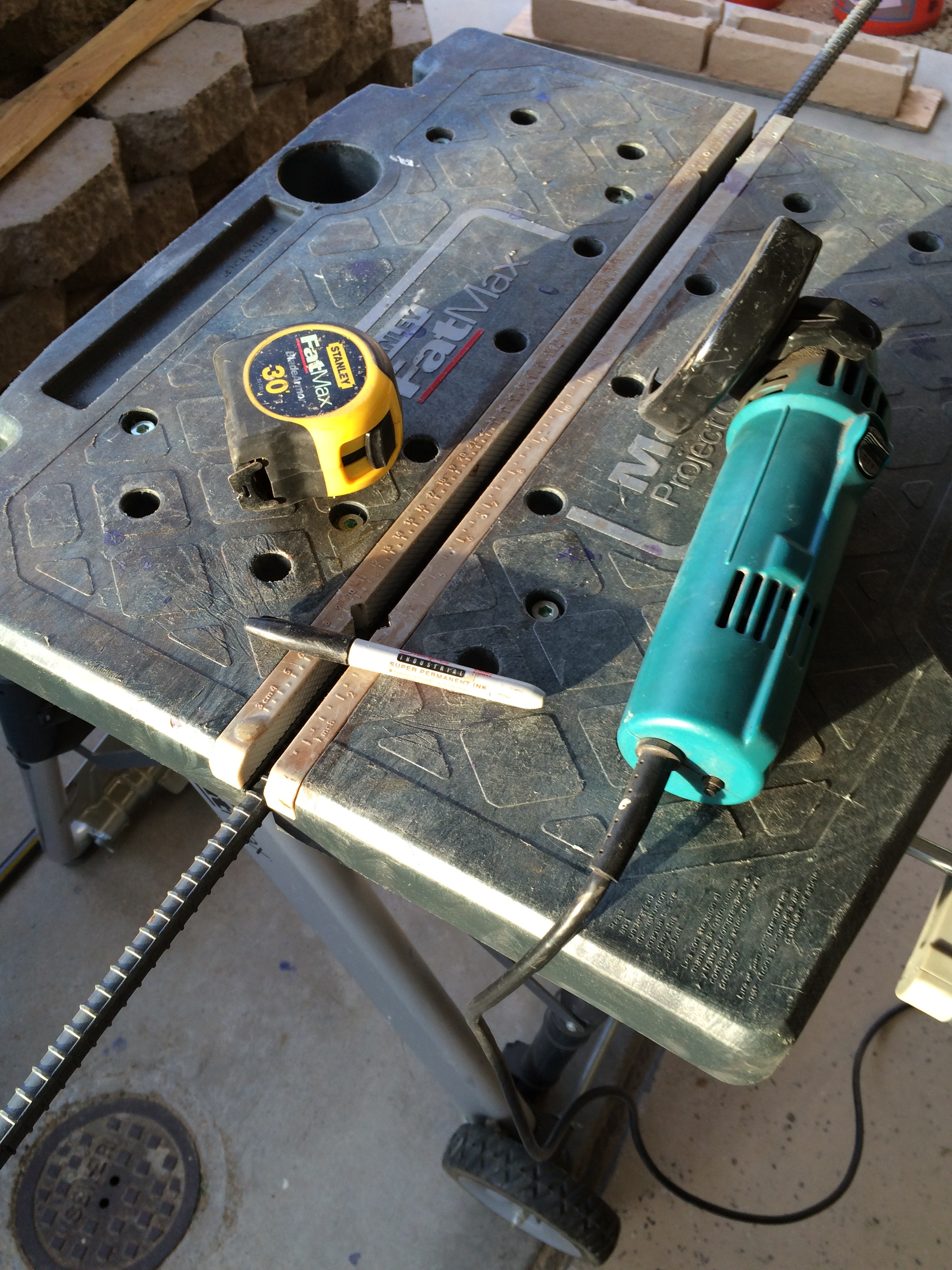
Tools for rebar cutting: Measuring tape, 4" grinder, work stand (work-mate or equivalent) and a sharpie.

Tools for rebar cutting: Measuring tape, 4″ grinder, work stand (work-mate or equivalent) and a sharpie.

Bent rebar, cut blocks, and mortar, ready for assembly

Bent rebar, cut blocks, and mortar, ready for assembly

Finished lintel. I didn't pound it, like Mike did, so I hope it will be OK.

Finished lintel. I didn’t pound it, like Mike did, so I hope it will be OK.

Time for cleanup. Always keep your tools clean (especially masonry tools) and always clean up after a day's work. My dad taught me that.

Time for cleanup. Always keep your tools clean (especially masonry tools) and always clean up after a day’s work. My dad taught me that.


Now, I’m ready for the President’s Day long weekend, and I’m very much looking forward to it. This will be the culmination of a lot of work in that this will be the construction of something that will be actually be permanent and seen by all. Stay tuned…..


How To Be A Safety Pro

Yesterday, I set about digging (again!), this time for a foundation for a masonry fence. Because the excavation for the foundation was right next to the sidewalk, I knew I would have to provide some kind of barrier and visual key that there was a deep (2’+) and potentially dangerous trench next to where people would be walking. Seriously, if you ended up walking into this thing, you would almost certainly break your leg, or worse, and that’s a liability I’d rather not have to bear. More importantly, being safe and providing barriers and warnings to potentially hazardous areas of your work shows consideration for those around you, and is just plain common sense. That got me to thinking about safety, and when you’re doing any kind of handy work, safety needs to be an integral part of how you approach the job.

OPEN TRENCH BARRIER

OPEN TRENCH BARRIER


First, you have to protect yourself. That means things like gloves, safety glasses, proper footwear (steel-toed boots-yes, flip-flops-no), hearing protection, breathing protection, and hearing protection. Of course, you’re not going to necessarily use all of these at once, but this always has to be part of the thought process before you proceed with whatever the next step of the operation happens to be. Almost always — safety glasses. I’ve spent way too many times trying to get crap out of my eyes and I’m probably lucky I’m not blind by now.

Second, you have to be aware of the hazards around you. Is that wire or electrical box hot? Have you checked? Is that pipe under pressure? Is my ladder stable? Will something fall on top of me? Do I have a bunch of trip hazards I have to watch out for?

Third, be considerate of the people who may be around you. Cordon off public areas where there may be hazards. Clean up after yourself. Make sure that you have a clear path around your worksite so that people can go where they have to without stumbling around in your mess.

At any rate, I finished my digging and put up an effective barrier. Those traffic barriers sure come in handy! Here is a short video of the work.

Now THAT’s Pro!

One of the great pleasures of DIY endeavours, at least for me, is to step back and have that first look at the finished product. Not only is it gratifying to see all of your planning and work become manifest, but if you do it right, you can take a lot of pride in a job that looks like it was done by a professional. On the other hand, if it looks bad, then that’s not such a good feeling as you will (a) have to do it over, or (b) figure out a way to hide the mistake. I remember a saying of one of my fellow woodworkers who said, “The difference between an inexperienced and experienced woodworker is the amount of experience you have in hiding your mistakes.” So, I usually focus on plan (b).

But today, there was no need for a plan (b). I finished the installation of my new irrigation system (well the underground portion at least), and it looks really good. Here are some pictures:

FRONT IRRIGATION PIPE LAYOUT

FRONT IRRIGATION PIPE LAYOUT

FRONT IRRIGATION BOX

FRONT IRRIGATION BOX

BACK IRRIGATION CONTROL BOXES

BACK IRRIGATION CONTROL BOXES


Notice how the lines are all neatly placed, the joints properly made, and how the control wires are secured around the piping? I also used some of the costs I saved by doing the labor to buy parts that are used commercially (e.g., for golf courses and such). This means that the system will last a long time, be easy to maintain, and perform well. It looks like a professional installation.

Alas, all of that nice, precise work has to be covered up. In reality, if I did a sloppy job of hooking up the pipes and just throwing the wires in there, nobody would have known the difference. Except for me. And you, who are reading this post. Nevertheless, I was happy to get all of the trenches covered up so I could walk around my property again! Here is what it looks like now:

FRONT YARD AFTER BACKFILL

FRONT YARD AFTER BACKFILL

SIDE YARD BACKFILL

SIDE YARD BACKFILL

I can now walk around in my back yard (again)!

I can now walk around in my back yard (again)!

How Many Hats Do I Have? — A Short Essay On Project Management

Yesterday, I was picking up some materials at one of my local suppliers (Home Depot). I got there just when the store opened (0600), yet I wasn’t ready to do any “real” work until 0900. What’s up with that?

Actually I was engaged in a lot of activity because I had to rent the truck, wait for the materials to get forklifted to the truck, drive back to the house, unpack, unload, dispose of the packing material, drive the rental truck back, top it off with gas, and then drive back to the house.

Turns out, that whenever you take on a home improvement project of any size, one of the critical tasks is to get your materials. In addition, there are a number of other tasks that need to occur before you commence “real work”. (By “real work” I mean doing the deed. Measuring, cutting, digging, assembling… whatever your concept of “real work” may be.) My Dad always said: “Always have a plan.” For simple tasks, this can be a drawing on the flap of an unused cardboard box. I did this today when I was laying out a manifold for my irrigation system. For more complex tasks, you might need dimensional drawings or a 3D model. Yet, this kind of “plan” is only one-dimensional. Well, really 2-D, but it oversimplifies the task of planning. Planning includes ALL of the tasks necessary to complete a project (of any size). Here is a list of common tasks that are necessary predecessors for “real work” in the context of DIY home improvement:

  1. Define your task. This is the fulcrum around which everything else rotates. Do you want to remodel your kitchen? Do you want to have an accessible bathroom? Do you want to have a water-conserving landscape? Do I want to put in new flooring? (Yes to all.)
  2. Make a drawing. A drawing will force you to detail  critical information. What kind of cabinets do I want for my kitchen? What kind of shower to I need to make my bathroom accessible? What kind of irrigation system do I need to have a water conserving landscape? What kind of flooring do I want? How big? How much? What shapes? As you answer these questions, your design will become increasingly more detailed, and from this, you can not only get an idea of how you’re going to put things together, but also be able to extract a list of materials. This is crucial to the next step.
  3. Source and obtain your materials. I remember before the Internet that I used to spend hours roaming the aisles of the big box stores just seeing what materials were available for my project. Now, I spend hours roaming the Internet. The cool thing is that I now have access to exponentially more choices of materials, and most come with free shipping, so I don’t even have to leave the house. Stuff just shows up. As a matter of practice, I develop my material list in conjunction with the design process, so by the time I have finished the drawings, I also have my shopping list.
  4. Perform a cost estimate and obtain financing. OK, for simple projects, that may mean taking $200 from your savings account. But for bigger projects, like a home remodel, this step is more integrated with the planning process as you will be making trade-offs with your design. Cost estimation is a science unto itself, and there are some good software tools out there when it comes to estimating residential construction projects. I did a detailed cost estimate using an online program called Clear Estimates just before I had my plans approved. Not only did I get a good figure the cost of my remodel, but I also was able to get estimates for the work I plan to contract out. Now I have some benchmark costs so I can better evaluate the bids of the subcontractors.
  5. Set aside time for the project. You want to have a block of free time that allows you to have an uninterrupted workflow to make the job go faster, and minimizes repetitive set-up times. Planning when to work on the project also helps you schedule your material procurements and deliveries. Frequently, deciding on when I’m going to do a project is the first thing that I do because it helps me plan and complete all of the predecessors (task definition, design/drawing, and material procurement). Deadlines are an effective motivator.
  6. GET TO WORK! Finally!

The steps above are the essence of what is called “project management”. It’s actually pretty straightforward if the project is simple, and if the project is larger, you just have to break it down into smaller chunks until what you’re left with are a bunch of simple projects. Here is where it gets interesting. This collection of simple projects, representing a much larger project, is not just a “honey-do” list. These sub-projects are interrelated. Some tasks have to be completed before others can start. Some tasks can be done in parallel. Some tasks require specialized skills which are best left to professional contractors. So, answering the questions of “where to start” and “what’s next” can become quite complicated. Large commercial projects develop what is called an “Integrated Master Schedule” (IMS) which typically uses computer software (e.g., Microsoft Project) to logically link all of the sub-tasks and assign labor and material resources to each task. In theory, you can get an accurate estimate of how much the project will cost and how long it will take. In reality, there are ALWAYS cost overruns and ALWAYS schedule delays, largely due to the facts that (a) there is always a measure of uncertainty in planning any project, (b) the bosses will tend to be overly optimistic because they want to win the bid, and (c) the customer frequently has a change of mind, which results in a change in the plans, and things just cascade from there. I actually have experience with doing this, and I made up an IMS for this home remodeling project about a year ago. That schedule showed that I would complete the project sometime later this year (2015). Alas, the IMS was difficult to keep up to date, and since I’m the only guy working the project, I made a choice to ditch the IMS in favor of doing “real work”. Needless to say, I now only have a vague idea when I’m going to finish, and I’m not quite sure what the final cost is going to be. All I know is that I’ve been stopping by Home Depot almost every day to pick up yet another part that I seemed to have overlooked in planning.

So, as the only person who is working this project, I need to wear many hats. Designer, draftsman, planner, scheduler, estimator, finance manager, procurement specialist (shopper), shipping and transportation (bring the stuff home), warehouse manager (store the stuff), general contractor, and finally tradesperson. I’m sure I left something out, but I think that’s enough to illustrate the point.

Now, when you see a construction crew at work, realize that there is a lot of action behind the scenes that is necessary to support that work. Even if that construction crew is a crew of one.

Here are some pictures of my warehousing operation:

WAREHOUSE

WAREHOUSE

WAREHOUSE  Do you see my ShopSmith?

WAREHOUSE
Do you see my ShopSmith?


I Always Wondered What It Was Like To Be a Ditch Digger

In my childhood, my parents would admonish me to do my homework and get good grades at school because “you don’t want to be a “ditch digger” when you grow up!”. The implication was that the profession of being a ditch digger was low brow, low rent, and definitely not in consonance with my (supposedly) superior skill set.

Fast forward several years to an experience I had while I was participating in a simulated undersea battle as part of my professional education as a nuclear submarine officer. I was assigned a lowly position that is typically assigned to a junior enlisted person on a sub. The instructor told me to use my (supposedly) superior skills as an officer to come up with the correct answer to shoot the enemy submarine up its butt. Which I did. This was an important lesson for me because it taught me that there are subtleties and nuance in lowly tasks which can be leveraged to produce a superior result, provided that you pay attention. And use your (supposedly) superior skill set. Mom and Dad, I hope I made you proud.

One of the lowly tasks that I’m having to perform as part of this remodel is to dig ditches. This is very important because there are myriad underground services which are part of the infrastructure of the modern home. The list includes: water, sewer, electricity, cable/internet, site drainage, and irrigation. All of which require a “ditch digger”. It turns out that ditch digging has some subtleties and nuances that become more obvious once you actually have to start digging. In today’s world, most of the work of “ditch digging” is assisted by machines, which makes the profession of heavy equipment operator the parallel of the “ditch diggers” of yore. If you actually get to talk to one and show interest in what they do, you find out it’s much more of an art, like a sculptor of sorts. It’s just that you’re using big machines and the medium happens to be dirt. But sometimes it’s back to picks and shovels, especially when you’re digging around live electrical lines, and water and gas lines under pressure. And heaven forbid, you certainly don’t want to cut your cable or telephone service and be without football and Facebook!

Because I knew I would have to do some digging by hand anyway, I assessed the value of renting a trencher, which is a machine with a bunch of dirt scoops on a chain that loops around a digging bar — sort of like a chainsaw. But they aren’t cheap to rent and I would have trouble fitting it into the tight places I needed to. So I decided to do it all by hand. Heck, I needed the exercise!

So, what does a “ditch digger” have to do? Well, it’s as easy as 1-2-3!

1. Get the proper tools. OK, so a shovel is a given. But what kind of shovel? Flat? Point? …. Turns out that there are a lot of implements that are available to deal with dirt. If you’re trying to dig up a large volume of dirt, then a bunch of dirt, then a point shovel is what you need. If you’re trying to scoop up dirt from the sidewalk or a flat surface, then the flat shovel is best. If you’re trying to dig a deep hole with vertical sides, then use a post hole digger. Trenches are best attacked with a trenching shovel. If you have to deal with rocks and/or clay, then you’ll need a pick and/or a mattock. A hoe and a rake are also useful. For most jobs, you’ll end up using several tools, depending on the demands of the moment.


DIGGING TOOLS

DIGGING TOOLS

1a: Pick. Used to loosen up dirt (esp. clay) and dig out rocks. Wear safety goggles! 1b: Post Hole Digger. Used to dig, well, holes for posts. Also very useful when you have something deep to dig and want the hole to have straight sides. 1c: Trenching Shovel: Used to dig trenches (what a surprise). The technique involves starting the trench with one of the other tools, and then sliding the trenching shovel back and forth along the bottom of the trench. 1d: Flat Shovel. Good for skim cutting the ground for a nice flat grade, or for shoveling bulk material (e.g., gravel or sand). 1e. Point Shovel: Used for digging big holes and moving a lot of material.If the ground is soft enough, then you can jump on it and the blade will penetrate the ground. 1f. Hoe. You’d be surprised how useful this is. It’s good for spreading materials, gathering up materials, and cleaning up trenches. 1g. Mattock. This is used to break up the ground. It has a sharp point like a pick, and a blade on the other end that is really good for trenching because it allows you to break up the dirt in just the trench and leaves a nice clean cut.


2. Figure out where the services have to run to and from and mark out the layout. For me, this was relatively easy because I had to submit plans for approval, so I had it all on paper. Easy from a bird eye’s (i.e. “plan”) view. But you have to remember that there is the “up-and-down” dimension. Here are the plans for the drainage and irrigation:

DRAINAGE PLAN

DRAINAGE PLAN

IRRIGATION PLAN

IRRIGATION PLAN


3. Figure out the depth. Most underground services need to be buried a specified minimum depth. For my new 200A electric service, that turns out to be 36″. That’s pretty deep if you’re digging a ditch by hand! If you’re installing drainage, you need to make sure that gravity works for you, and thus need to make sure that the drain pipes have a slope of at least 1% in the direction you want the water to go. So now, you have to figure out a way to determine elevation. 3-dimensional space is wonderful, don’t you think?

Here is how I did it:  To transfer the measurements from the plans to the actual drawings, I decided to use a system of lines that were centered on the trenches I needed to dig, and set at a constant, reference elevation. To do that, I used what are called “batter boards”.  These consist of two upright stakes driven into the ground with a cross piece. You install this arrangement at either end of the trench, set the height of the top of the cross piece to the chosen reference height (I used the weep screed of the house), and then string a line between the cross pieces. Volia! A perfectly straight line at the reference height.

BATTER BOARD

BATTER BOARD


Here is a link to a really nifty video on how to run string lines.

The next step was to set the drainage basins in position, mark where they needed to be on the dirt, and dig a hole for each one. I would dig until I got the bottom of the basin to where it needed to be based on the plans. You may need to do a little arithmetic to get the answer for the right depth. For instance, I needed the top of the drain to be 4″ down from the reference (weep screed), plus 2% of the distance from the house, which was 2.5″ (10′ = 120″x2% = 2.4″), so 6.5″, and the distance from the top of the drain to the bottom of the basin is 12″, so 6.5″ + 12″ = 18.5″. Really no big deal (unless you are challenged by arithmetic).

BASIN IN POSITION

BASIN IN POSITION

DIGGING THE HOLE

DIGGING THE HOLE


CORRECT HEIGHT (DEPTH)

CORRECT HEIGHT (DEPTH)


Then you dig the trench between the catch basins, and you know that the depth of the trench will be correct because you’ve set the depth of the basins. With the string line, you can easily measure the depth at any point along the line to confirm that you’re digging to the correct depth. Here are some pictures of the finished product.


DRYWELL TRENCH

DRYWELL TRENCH


DRYWELL PIPING

DRYWELL PIPING

FRONT DRAINS

FRONT DRAINS


One of the things that I didn’t give much thought to was where to put the dirt. In my brief career as a ditch digger, I simply assumed that it would go next to the hole. However, this became problematic as progress continued with the “moat” I was digging around my postage-stamp size lot. This was complicated by the fact that ALL of the digging and installation of underground services must be complete so that the inspectors can give their approval before you cover it up. Towards the end, it became quite a challenge to navigate my way around the property between the high-wire walk along the trenches, and having to step over those batter boards.

DIRT PILES

DIRT PILES

PETRIFIED POTATOES

PETRIFIED POTATOES (I ran into lots of rocks. THAT was fun!)


Eventually, the inspectors came, gave me the thumbs up (yaay!), and I was able to start covering up stuff. You’d think that filling up a hole with dirt would be pretty simple. But yet again, there is nuance. You need to compact the dirt as you go because if you don’t, it will settle and at best leave you with gullies where the trenches used to be, and at worst, cause underlying structural problems with your concrete, or whatever you put on top of the dirt. Alas, the other realization I came to was that what goes out, must go in, and so the large amount of digging resulted in a large amount filling. That gosh-darned dirt seems to get heavier with each shovel-full!

ELECTRICAL SERVICE TRENCH (Before)

ELECTRICAL SERVICE TRENCH (Before)

ELECTRICAL SERVICE (After)

ELECTRICAL SERVICE (After)


The great news is that the outside of the place is never going to look worse than it does right now, and I’ve actually begun installing things instead of demolishing stuff and hauling away the detritus. Speaking of detritus, does anybody have any suggestions for getting rid of the rocks that harvested? People buy this so-called “river rock”, so maybe I can give it away. Too bad the Pet Rock fad is over. I’d be sitting on a fortune!

Happy New Year! Reflecting on 2014 and Looking Forward to 2015

The turn of the year is always a good time to reflect on the past year and look forward to the next. It’s a common demarcation point, and it occurs when we’re collectively given the time to reflect and plan, according to our nature. I know what you’re saying” “If you’re in retail, or emergency services, or in the military on deployment, the maybe I’m not given the time.” However, I think because of the time of year, everybody is doing it, and you can’t help yourself. Actually, serving your customers, community, or country can have special meaning at this time of year.

OK, well maybe not so much in retail.  As they say, anybody who says there are “No stupid questions!” has NEVER worked in customer service. You know, retail is a dang hard job, and I truly appreciate everybody who helps me when I’m shopping.With a smile and a kind word, you will always get superior customer service! All you have to do is to distinguish yourself from the a**hole who decided to take out their frustrations on some poor, underpaid retail associate who is constantly bombarded by yet another a**hole! But you have to remember to take the time to take the survey and say nice things. If you REALLY want to reward good customer service, then have the presence of mind to remember the name of the person who helped you, and then take the time to make a positive comment  on the survey, or the website. These people get promotions and monetary rewards for this kind of stuff. So, the lesson is: Be nice, and when you get good service, make sure you tell the boss!

Where was I?

Reflections on 2014: I had been planning my remodel since 2012, when my lovely wife and I started discussing concepts and the things that we really wanted out of  life, and how our home would reflect that. At the beginning of 2014, I had finished detailed planning and had drawings that I thought were good enough to submit to the city building department for approval. 8 months later, after 3 revisions, I finally got the building permit! Actually, I didn’t wait to get the building permit do start work. I knew that I needed to take out my patio in back, and I wanted to save the bricks and sand. That was a major undertaking which filled the dead time in between the review of the latest plan revision, and answering the comments for the next plan revision. Once I got the building permit, I started in earnest, with site demolition, excavation, and installation of underground services.

What I learned:

  1. If you don’t follow the prescribed approach in the codes, then you will have to have a licensed engineer sign off on your plans. For a small job, it’s not worth it (and they were kind enough to tell me that). Learn the codes and follow the prescriptive approach.
  2. Take each “rejection” as an opportunity to improve your design. I can say that my plans have been significantly improved by having reworked them for the building department.
  3. Detailed planning helps you build faster. My plans have speeded up my work (thus far) in ways that I could not have imagined before.
  4. Detailed planning does not account for everything. Inevitably, you run into unexpected obstacles. The fittings don’t fit like you expected. You need to change the routing of the conduit to account for other buried services. Remain flexible and adapt. “No battle plan survives first contact with the enemy.” (Field Marshal Helmuth von Moltke.)
  5. Know when to quit for the day. Something my dad taught me.  This is a big project and you have to know your limits. If you push too hard, then quality suffers. It’s OK to have goals, but sometimes (OK , frequently), the goals are too optimistic. There are only so many hours in the day, and you need to take care of yourself. So know when to quit for the day, and make sure that you leave enough time for clean up!

Goals for 2105:

  1. Don’t get injured. Building can be dangerous if you’re not careful!
  2. Keep my job. Don’t get too involved in the remodeling at the expense of the day job. Yes, I still have to pay for all of this somehow.
  3. Go to Smithfield, VA for my  wife’s 50th high school reunion.
  4. Finish the site work. I’m optimistic this will be done by March. But who knows?
  5. Move out of the master bedroom, and do the demo.
  6. Build the addition and close in. I’m hoping by July-August. Before the rains come in any case.
  7. Install A/C. That will be contracted out.
  8. Install a new roof. Also contracted out.
  9. Re-stucco the front. Yet more contract work.
  10. Paint the house. Did I mention contract work?
  11. Install new electrical service. This will be all me. Wish me luck!
  12. Don’t take the remodeling too seriously. Yes, it’s important to have goals and to work hard to achieve them, but in the end, this is supposed to be rewarding and it’s important to take pride in one’s accomplishments. Otherwise, I’d be hiring somebody to do all of this!

I wish all of you a very happy New Year, and I hope that you continue to follow my blog. I’m working on an epic post for digging ditches!  Stay tuned……

A Home Remodeling Christmas

In my last post, I mentioned all of the “Christmas” shopping I did in getting all of the parts for my buried services. I’m deep into digging (more on that later), and I actually am looking forward to spending some dedicated time over the Christmas and New Years holiday to make some really good progress.

As usual after Thanksgiving, our neighbors decorated their homes with lights, and it really makes the street look nice. We would always participate, putting up some tasteful white lights and some garlands. In fact, my remodeling plans call for an exterior plug, controlled by a switch, that will be installed expressly for Christmas lights.

But that is in the future, and for now, I felt I had to come up with something that was appropriate for the season, yet fit our “decor” of a torn up yard, complete with piles of dirt and trenches. Honestly, the exterior of the house and property will look no worse than it does at the moment. What a friggin’ mess! Then, in a flash of insight, I had the answer!

My lovely wife always encourages me to “use what I have”. I think this comes from her Scottish heritage, and I appreciate and admire her way of making elegance out of frugality. In rising to that challenge, I took a look at these traffic barriers that I had, and it gave me an idea. I was required to buy traffic barriers with flashing lights for the dumpster(s) that I needed to put on the street, marking where the dumpster was, lest an errant driver not see it and run into it at night. I swear that the drivers around here are so fu#&*@’n dumb that they don’t need any assistance from alcohol to run into a dumpster in broad daylight. And swear I do. Profusely. When I’m driving.

Back to the point. These traffic barriers have flashing lights. And, I have my strings of Martha Stewart LED outdoor Christmas lights. AND I have a bunch of “CAUTION” tape. What a great combination! So, I placed the traffic barriers in a tasteful manner across the front of my yard, strung my Martha Stewart lights tastefully between them, secured the assembly with tasteful CAUTION tape, and put the lights on a timer that I had from my (now defunct) pond. This arrangement has the added advantage of discouraging errant people on the adjacent sidewalk from stumbling onto my property and breaking their legs when they trip into one of the many trenches that await their drunken follies. (OK, they have to be drunk, but that is not outside the realm of possibilities.)

Although I try to elicit visual pictures with my writing, this video is worth 454 words.  Good thing this blog has a word counter, otherwise I’d be guilty of false representation! (OK that’s 472 words).

Everyone have a wonderful holiday season, and I promise I’ll have more posts in the near future.

Shopping for Parts — What Else Would I Do On Black Friday?

As the last bits of excavation and site preparation come to fruition, the project is now entering the phase where I have to actually start buying materials. When I was making my plans, I did a lot of research on the Internet to make sure I could source the critical parts that I needed, and I did some preliminary estimating. Even though it was quite helpful, things become more serious when you start putting cash on the table. Back in the day, I would spend hours perusing the aisles of the big box stores, writing down prices and in general figuring things out. Now I spend hours on the Internet, copying and pasting prices and in general figuring things out. At least I don’t have to waste time travelling to and from the store. And I can sip a beer without fear of arrest.

All kidding aside, the Internet and stores with an on-line presence are the best thing that has happened to DIY’ers since, well, DIY. Not only can I check inventory and prices, but I can also source difficult to find products and have them shipped to me. For example, I was looking for an irrigation controller that was set up for a smart home, and I found one for sale directly from the manufacturer (Irrigation Caddy). It has an ethernet port, controls 10 zones, and has a rain sensor option. Boo-Yah! In addition, many of these stores have a lot of how-to’s. I completely figured out my outdoor 12v lighting system from a website that sold lighting parts directly from the factory (Landscape Lighting World). They had tons of how-to videos and some very practical advice on landscape lighting. Their products seemed pretty good as well, and when I compared prices, they were reasonable, so I ordered from them.

The big box stores also have significant online presence, and the ones that I use (Home Depot and Lowe’s) have convenient features on their websites that allow you to develop lists. However, sometimes navigation of that all that stuff is tricky. For instance, if you type in a key word on the Home Depot site, you get results that are typically incomplete. The best way to search is to drill down from the home page once you find the department where the product is located. The other hassle is that sometimes you get things that are in the store, which get pulled immediately, and other things which have to be shipped to the store. So I get several e-mails and texts urging me to hurry to pick up my in-store order (and being threatened that they will cancel it) while they haven’t even shipped the balance of the order to the store. I eventually straightened that out, but really, HD should figure out a way to let me know when the complete order is ready for pick-up. Then some items they won’t ship to the store and they’ll charge you to ship it to your home. For example, I wanted to order some drain pipe, and the price was $28, but the shipping was $55. No thanks.

Of course, sometimes they won’t have what you want. Mostly, I try to figure out a way to order it from someplace that has free shipping like Amazon, but in some cases, that’s impractical. So, it’s back to the big box store where you can ask if they can do a special order. My experience with these is pretty positive, because the folks at the special order desk typically have a lot of experience, and they will do thorough research. If they can order the part, you’ll have it in a few days. If they can’t they usually will give you good advice about who may have it.

Lastly, sometimes you really need to see the product in person. Thus far, I’ve been pretty fortunate in that I’ve been looking up the product specifications on line while I was in the planning phase, so I have a very good idea of what I want and how much I need. This works fine for commodities (pipe, wire, fittings), especially if they’re hidden. If they’re not, then you have to start worrying about color and texture, and shape, and … all that stuff that I’m not very good at. So, because my wife has a far superior sense of style, I enlist her help when it comes to these things. She also has a vested interest because she doesn’t want the house to look like I dress. Well, ok,  like I USED to dress before she started picking out clothes for me. Now, I have to busy myself in obtaining “samples” so we can carry them around when we look at materials. These samples go beyond paint samples, although that’s included. We’re talking brick, retaining wall blocks, roofing shingles, … etc.. I hope I don’t need a truck to haul this stuff around! Actually, I exaggerate. All we really need are paint samples and a piece of roof shingle. Be that as it may, my wife is correct about getting all this stuff together to see what it looks like in person. Pictures on the Internet can fool you when it comes to colors because there are so many variables (lighting direction, lighting color, camera settings). Sometimes you can get the data, such as RGB values, for colors, and that can help with computer rendering. But bottom line is that you need to see things in person to make sure. Especially if you’re buying several pallets of bricks for a brick wall. I have a feeling that would be WAY more difficult to return than a pair of bunny slippers.